

What Are the Fence Rules in WildLight, Nassau County, FL?
You moved into WildLight, the puppy is home, and the backyard is wide open. Now you’re realizing that a fence isn’t as simple as calling a contractor and picking a color. WildLight’s Architectural Review Committee has specific requirements for what you can build, where you can put it, and what it needs to look like. Most new homeowners don’t find this out until they’re standing in an unfenced yard or, worse, until they’ve already started installation without approval.
This guide covers what WildLight homeowners typically need to know before starting a fence project: the ARC process, approved materials, common restrictions, and the Nassau County permit requirements that sit on top of HOA approval.
One important note before we get into it: WildLight’s governing documents are maintained by the HOA and can be updated. Always verify current requirements directly with the WildLight Community Association before submitting your application. Treat this article as a starting framework, not a substitute for the official guidelines.
WildLight’s ARC: What It Is and Why It Matters
WildLight is a master-planned, mixed-use community and neighborhood located within Yulee, Florida, in Nassau County, developed by Rayonier Advanced Materials. Like most master-planned communities in Northeast Florida, it’s governed by a homeowners association with an Architectural Review Committee. The ARC exists to maintain consistent aesthetics across the neighborhood. That means your fence needs to be approved before a single post goes into the ground.
Installing without ARC approval isn’t a gray area. The HOA has the authority to require you to remove a non-approved fence at your own expense. That’s a painful and expensive outcome. Get approval first.
Approved Fence Types & Materials in WildLight
WildLight’s ARC guidelines generally favor low-maintenance, visually consistent materials. Based on standard requirements for communities of this type in Nassau County, the most commonly approved fence materials are:
- Aluminum (ornamental style with flat-top or spear-top profiles)
- Vinyl (specific profiles such as privacy panels or semi-privacy, depending on yard placement)
- Coated steel (in select applications, typically commercial-adjacent or utility zones)
Wood fencing is often restricted or requires specific conditions in master-planned communities like WildLight because it weathers unevenly and can detract from neighborhood consistency. Confirm with the HOA whether any wood styles are currently approved for your lot.
Chain link is typically not approved for residential lots visible from streets or common areas in communities of this caliber.
Approved Colors
Color restrictions in WildLight generally align with what’s standard across Nassau County HOA communities: a short list of approved options that vary by lot type and placement:
- Black (most commonly approved for aluminum fencing)
- Bronze (common alternative for aluminum)
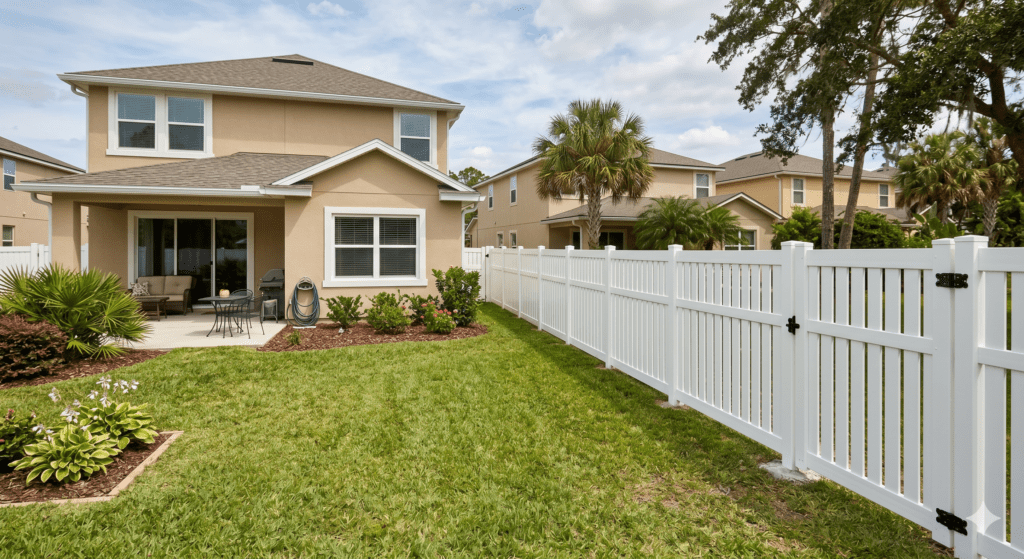
- White or tan (typically approved for vinyl privacy fencing in rear yards)
The specific approved color for your lot may depend on your home’s exterior color palette and your lot’s position in the neighborhood. Homes backing conservation areas or community green spaces sometimes have additional restrictions. Check the ARC guidelines specific to your section of WildLight.
Height Limits: Rear Yard vs. Side Yard
Height allowances in WildLight follow the pattern common to Nassau County residential communities:
- Rear yard: Up to 6 feet is typically allowed for privacy fencing
- Side yard: Usually limited to 4 feet, and side yard fencing may only extend to a specific point along the home’s footprint
- Front yard: Fencing forward of the rear building line is generally not permitted
The “rear building line” rule is the one that catches most homeowners off guard. It means your fence can’t wrap around to the front of the house. In practice, this usually restricts fencing to the area behind the rear wall of your home, though some communities allow fencing to extend along the side yard back to the rear building line.
Setback Requirements
Setbacks define how far your fence must sit from your property line. WildLight’s ARC typically requires fences to be placed within the property line, but some governing documents specify a minimum setback of 6 to 12 inches from the property boundary. This is partly to allow for maintenance access and partly to avoid encroachment on easements.
Before installation, get a current property survey. Don’t rely on a plat map alone. In newer neighborhoods where construction and grading are still ongoing, physical property markers can shift or become buried. A recent survey protects you from an encroachment dispute with a neighbor and is typically required as part of the ARC submission package anyway.
Also check for utility and drainage easements on your lot. In WildLight, lots that back conservation land or retention areas often have rear easements of 10 to 15 feet or more. You can’t fence across an easement without permission from the easement holder, and the ARC won’t approve a fence that does.
Common WildLight Fence Questions
Can I install a privacy fence?
Generally yes, in the rear yard. Six-foot privacy panels in an approved color (typically white or tan vinyl) are the most common approval in communities like WildLight. What you can’t do is extend that privacy fence into the side yard without ARC review, and you typically can’t use full-privacy panels in the side yard where they’d be visible from the street.
For vinyl fencing options that meet HOA specifications, Fortera offers privacy panels and semi-privacy styles that are commonly approved in Nassau County communities.
Can I add a gate to the side yard?
Yes, side yard gates are generally allowed, but the gate style and height must match the approved fence design. You’ll need to include the gate specifications in your ARC submission. A 4-foot aluminum side gate with a self-latching latch is the most typical approval in communities like WildLight.
Do I need to match my neighbor’s fence?
Not necessarily, but you do need to stay within the approved style and color list. Two neighbors can have different approved fence styles as long as both are independently ARC-approved. That said, some sections of WildLight may have stricter consistency requirements if the ARC has designated a preferred style for that block or phase.
What happens if I install without ARC approval?
The HOA has the authority to issue a notice of violation and require removal at your expense. In some cases they’ll levy ongoing fines until the fence is brought into compliance or removed. Beyond the financial hit, an unapproved fence can complicate a future home sale. Buyers’ real estate attorneys look for open violations in HOA records during due diligence.
How to Submit an ARC Application for a Fence in WildLight
Here’s the general process for getting ARC approval. Timelines and specific document requirements can vary, so always confirm current requirements with the WildLight Community Association office directly.
Step 1: Get the current ARC application form Contact the WildLight Community Association or access the resident portal. Most communities post ARC applications online. Don’t use a form from a neighbor or a previous homeowner. Forms get updated.
Step 2: Gather your documentation A complete ARC submission typically includes: – A completed ARC application form – A site plan or survey showing your lot, your home’s footprint, and the proposed fence location with dimensions – Fence material specifications (manufacturer data sheet or product description with dimensions and wall thickness) – Color samples or color codes – Gate details if applicable – Any photos of similar fencing in the neighborhood that matches your proposed style (optional, but helpful for approval)
Step 3: Submit and wait ARC committees in Nassau County communities typically take 15 to 30 days to review a complete application. Some WildLight sections may have faster or slower turnaround depending on committee meeting schedules. Don’t start work, don’t order materials, and don’t sign a contractor agreement contingent on a specific start date until you have written approval in hand.
Step 4: If you receive a denial A denial usually comes with written reasoning. Read it carefully. Common reasons include wrong color, height exceeding limits, or a fence extending beyond the allowed placement zone. You can revise and resubmit. If you believe the denial was applied incorrectly, most HOA documents include an appeal process with a defined timeline.
Nassau County Permit Requirements
HOA approval and a Nassau County building permit are two separate things. You need both.
Nassau County requires a building permit for most residential fence installations. Generally, permits are required for: – Any fence over 6 feet in height – Fences associated with a pool or spa (pool barrier code applies separately) – Any fence on a corner lot (additional setback rules apply at the sight triangle)
For standard 4- or 6-foot fences, permit requirements vary. Some jurisdictions require a permit for any fence regardless of height. Check with the Nassau County Building Department before starting.
Your contractor can handle permit pulling as part of the project. At Fortera, permit pulling is included in our pre-installation process where applicable, so you’re not left to navigate the county on your own. Before any installation begins, we also coordinate utility locates through 811 Call Before You Dig, which is a required step, not a courtesy.
For residential fence installation across Nassau County, understanding both the HOA and county requirements is part of our standard process. You shouldn’t have to figure that out alone.
Getting Your Fence Approved, Start to Finish
WildLight is a well-run community with specific ARC standards, and those standards exist to protect the look and feel of the neighborhood you chose. The process isn’t difficult when you know what to expect: get the current ARC application, submit a complete package with a site plan and material specs, wait for written approval, then pull your Nassau County permit. Only then does installation begin.
If you’re not sure whether your proposed fence style meets WildLight’s current requirements, or you want help putting together accurate material specs and color documentation for your ARC submission, reach out to Fortera. We work with homeowners across Nassau County regularly and we know what ARC committees expect to see.
Get a free, no-obligation on-site estimate. We’ll walk your property, review your HOA requirements with you, and give you a free estimate before you commit to anything.
Premium Fencing. Superior Experience.
Call to Schedule Your Free Estimate Now
Get started today with a free estimate and experience the professional, easy, and dependable service that sets Fortera Fencing apart.