Open: 8AM – 8PM | Mon-Fri
A 48-year-old homeowner in Mandarin is replacing the rotted wood fence that let the beagle out twice in one week. The crew arrives at 8 a.m., and by 10 there are four posts in the ground along the old fence line. Then the neighbor walks over holding a folded survey from 2009, and his copy shows the boundary running two feet inside those new posts. Work stops before lunch.
No Florida statute forced that homeowner to order a survey first, but nearly every Jacksonville fence project needs one in practice. The City of Jacksonville’s own zoning guidance says the sidewalk or curb isn’t where your property line starts, and that the land needs to be surveyed to determine the line accurately. A boundary survey on a standard quarter-acre lot runs $500 to $800 in the Jacksonville market, and ordering it before install day prevents that entire scene: no reset posts, no second crew mobilization, no feud across the fence line.
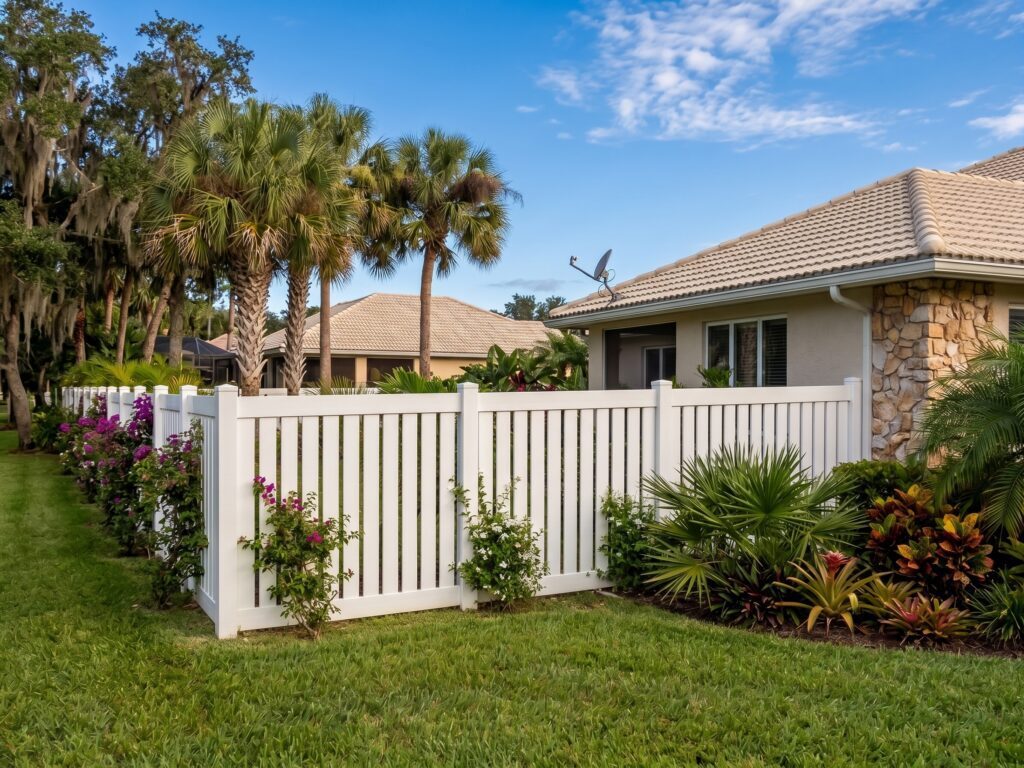
A survey is legally required whenever a permit application asks for one, and strongly recommended everywhere else. Whether a permit is required at all varies by municipality, since each city writes its own fence rules on top of the county’s. In Duval County, the City of Jacksonvillezoning FAQ states that a residential fence may be built on the owner’s property line or elsewhere on the property depending on the zoning district, and that a survey is what determines where that line sits. The beach cities go further: Jacksonville Beach requires a permit even to replace an existing fence, and requires a copy of your property survey showing where the fence is going, per the city’spermitting FAQ.
In Nassau, Clay, and St. Johns counties, the pattern repeats: when a project needs county review, the reviewer wants to see the fence location relative to your boundary and any recorded easements, and a survey is the document that shows both. Even where no office demands one, the survey protects you from the two expensive outcomes: building on your neighbor’s land, or building well inside your own line and giving up yard you paid for.
If you bought your home recently, check your closing documents first. Most buyers received a survey at purchase, and if nothing on the lot has changed since, it’s usually still usable.
Plan on roughly $500 to $800 for a boundary survey on a standard quarter-acre Jacksonville lot. Apex Surveying & Mapping, a firm serving the Jacksonville market, publishes residential boundary survey pricing of $500 to $1,500, with standard turnaround of five to ten business days; their current pricing breaks down by lot size and complexity.
Survey scenario | Typical cost |
|---|---|
Quarter-acre standard lot | $500-$800 |
Half-acre lot | $600-$1,200 |
One-acre, wooded, or irregular parcels | $800-$1,800 |
Most full-yard fence installs in the Jacksonville area land between $3,000 and $8,000 depending on material and footage, so a $500 survey is roughly a tenth of the project cost. It’s also far cheaper than relocating even one run of installed fence.
An easement gives someone else a legal right to use part of your land, and a fence can’t block that use. Three types come up constantly in Northeast Florida neighborhoods:
Stack these together and the practical fence line in some subdivisions sits five to 15 feet inside the legal boundary. Your survey shows the recorded easements; your HOA covenants show the rest. In Jacksonville, a fence placed in a city right-of-way or easement needs separate city approval before any permit is issued, so run this check before you price materials.
The owner who wants the fence pays for it, unless the neighbors agree otherwise in writing. Florida has no general shared-fence statute for residential properties; the state’s fence laws in Chapter 588 grew out of agricultural fencing and livestock containment, unlike states such as California, where Civil Code Section 841 makes both owners responsible for a reasonable boundary fence. According to FindLaw’s summary of Florida property law, adjoining landowners have no legal obligation to erect a fence at all, and a neighbor who didn’t agree to the expense in advance isn’t obligated to share it. FindLaw’s overview is a good plain-English starting point, and the University of Florida’s fence law handbook covers adjoining-owner rights, encroachments, and boundary lines in depth.
The legal default and the neighborly approach are two separate conversations. Plenty of neighbors split a boundary fence because both yards benefit. If you go that route, put it in writing: who pays what, who maintains which side, and where the fence sits relative to the surveyed line. A signed one-page agreement now beats a small-claims argument later.
Yes, if the fence crosses their line. An owner whose property is encroached on can demand removal of the encroaching section, and if you refuse, they can file a civil suit for trespass and seek an injunction compelling you to move it. A neighbor holding a current survey with your post on their side of the line holds every card in that dispute.
A neighbor has no veto over a fence built entirely on your own property that meets height, setback, and zoning rules. The one exception in Florida case law is the spite fence: a fence built for no purpose other than interfering with a neighbor’s property rights is illegal. A normal privacy or containment fence with a legitimate purpose doesn’t come near that bar.
The survey settles the argument before it starts. When your installer can point to fresh corner pins, the conversation with the neighbor ends in minutes.
A wood, vinyl, or chain-link fence six feet or under in the rear or side yard is generally exempt from Jacksonville’s building permit requirement, but zoning standards for setbacks and sight-distance triangles still apply. Anything over six feet, masonry construction, or a pool barrier requires a permit. That over-six-feet trigger holds in most jurisdictions across the four counties. Pool barrier fences must be at least 48 inches tall, fully enclose the pool area, and meet the Florida Building Code’s pool enclosure requirements, and a permit is always required for them. That four-foot minimum, along with self-closing, self-latching gates, is a safety obligation, and no fence should be treated as done until it passes.
The survey also does the permit paperwork for you. Applications ask for a site plan showing the fence location, and a current survey answers that with no extra drawing. Hand-drawn sketches are typically not accepted in Jacksonville because they aren’t to scale.
Run these five steps before install day and the project stays uneventful, which is exactly what you want:
One step never comes off the list: utility locate through Florida’s 811 service are mandatory before any digging or post driving. A professional installer makes that call as part of the job. At Fortera Fencing, utility locates and permit pulling where applicable are built into The Fortera Fencing Process on every fence installation across Duval, Nassau, Clay, and St. Johns counties, alongside a free estimate and a designated client manager from first call to final walkthrough.
Permit requirements differ from one city or county to the next, many HOAs set their own limits on fence height, materials, and what the street-facing side can look like, and some jurisdictions and neighborhoods want a current property survey on file before anything is approved. Instead of handing you a list of offices to call, we tell you upfront which of those apply at your address, help you put together what your HOA’s architectural review committee is asking for, and file the permit for you, so the approvals are in hand before the first post goes in the ground.
No. Florida sets no statutory expiration date for a boundary survey. If nothing has changed on your lot or your neighbor’s since it was drawn, an older survey usually holds up, though a recent one is the safer basis for a new fence line and the cleaner answer in a permit review.
In the City of Jacksonville, a residential fence may be built on the property line or elsewhere on the property, depending on your zoning district. Many owners still set the fence a few inches inside the line so ownership and maintenance stay unambiguous, and so future repairs never require the neighbor’s permission.
Talk to your neighbor as soon as you know, because encroachments surface during home sales when the buyer’s survey flags the fence. The clean fix comes at replacement time: pull the old fence and reset the new one on the surveyed line. If you’re planning a fence replacement anyway, that’s the moment to correct it permanently.
A fence should be the simplest construction project you ever commission. The survey, the easement check, the HOA sign-off, and one friendly conversation across the property line remove nearly every way it goes sideways. If your fence is sagging, storm-worn, or overdue, contact Fortera Fencing to schedule a free, no-obligation on-site estimate: we’ll walk the property with you, take measurements, help you choose the right materials and layout, and you’ll get a written proposal on-site, with no deposit required to book.
Premium Fencing. Superior Experience.
Get started today with a free estimate and experience the professional, easy, and dependable service that sets Fortera Fencing apart.
We use cookies to improve your experience. By continuing, you consent.
Manage your cookie preferences below:
Essential cookies enable basic functions and are necessary for the proper function of the website.
CloudFlare provides web performance and security solutions, enhancing site speed and protecting against threats.
Service URL: developers.cloudflare.com (opens in a new window)
These cookies are needed for adding comments on this website.
Google Tag Manager simplifies the management of marketing tags on your website without code changes.
Marketing cookies are used to follow visitors to websites. The intention is to show ads that are relevant and engaging to the individual user.
Facebook Pixel is a web analytics service that tracks and reports website traffic.
Service URL: www.facebook.com (opens in a new window)
Google Ads is an online advertising platform that enables businesses to create targeted ads displayed on Google search results and partner sites.
Service URL: policies.google.com (opens in a new window)
You can find more information in our Cookie Policy and Privacy Policy.