

Do you need a permit to replace a hurricane-damaged fence in Jacksonville?
In most cases, yes, but a new Florida law may exempt you if your rebuild costs less than $7,500 and your property sits outside a flood hazard area. The exact answer depends on which county you’re in, how tall your old fence was, and whether you’re rebuilding it the same way it stood before the storm.
Duval, St. Johns, and Clay counties all set their building-permit trigger at 7 feet, while Nassau’s sits lower at 6 feet, and a declared state of emergency changes the timeline in your favor.
Here’s the scenario, because it’s probably yours: the storm passed, the yard is a mess of splintered pickets or bent aluminum panels, and the fence that used to be there is now firewood in the side yard. The dog can’t go out back without a leash and a prayer. You’ve got a contractor ready to start Monday, and no idea if you need to call the county first or if that’s even possible this fast. Here’s what actually determines the answer.
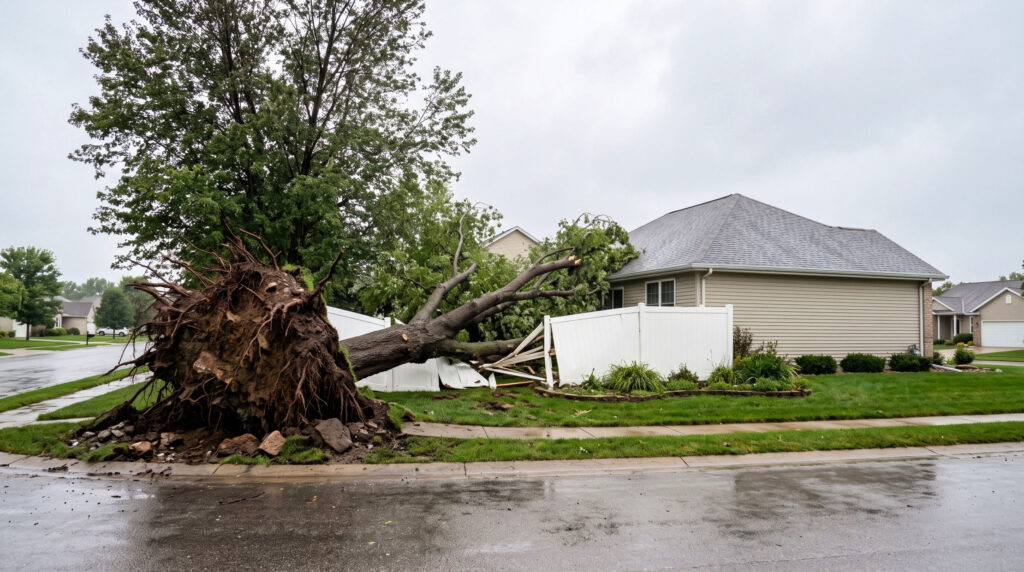
Florida’s new fence permit exemption after a storm (HB 803)
Florida House Bill 803, effective July 1, 2026, requires local governments to exempt single-family homeowners from the standard building permit requirement for qualifying work valued under $7,500. Under the Florida Senate’s bill summary, local governments must exempt work on single-family residential property valued at $7,500 or less from building permitting, except in flood hazard areas and except for electrical, plumbing, structural, mechanical, or gas work. Ordinary fence replacement generally qualifies since it isn’t one of those five excluded trades.
This is the single biggest reason a lot of storm-damaged fence rebuilds in Northeast Florida no longer need a traditional permit application. Many residential fence sections, especially wood and chain link runs on a standard quarter-acre lot, fall under the $7,500 threshold for a straightforward replacement, well below what a full property-wide fence and gate package would run.
There’s a wrinkle that matters most for hurricane damage. Clay County’s own HB 803 guidance lists repairing or replacing wood fence pickets and panels as a qualifying example, but treats fence post replacement separately, since the exemption excludes structural work regardless of cost. A hurricane that flattens a fence typically snaps or uproots posts, the more serious failure mode than a few broken boards, which is exactly the scenario this article covers. If your posts are gone along with the pickets, confirm with your county’s building division whether your rebuild still qualifies before assuming the sub-$7,500 exemption covers the whole job.
The exemption comes with real limits. It does not apply if any part of the property sits in a Florida Building Code flood hazard area, and a meaningful share of Northeast Florida properties near the St. Johns River, the Intracoastal, or coastal marsh fall into that category regardless of cost.
Qualifying doesn’t mean you skip paperwork entirely. Clay County’s own guidance is a good example: to use the exemption, the property owner or contractor must contact the county building division before starting the project so staff can confirm the work qualifies. Skipping that step turns a legitimate exemption into an unpermitted-work problem later, especially if you sell the house down the road.
Permit rules by county: Duval, St. Johns, Nassau, and Clay
Three of the four Northeast Florida counties use the same building-permit trigger for fence height. Nassau is the exception, and knowing which side of that line your rebuild falls on determines whether HB 803’s dollar threshold is even the relevant question.
County | Building permit generally required when | Notes |
|---|---|---|
Duval (City of Jacksonville) | Fence exceeds 7 feet | A separate 6-foot zoning height cap is enforced through zoning review |
St. Johns | Fence exceeds 7 feet | Zoning caps most fences at 6 feet (4 feet within the front 25 feet of the lot) |
Nassau | Fence exceeds 6 feet | The lowest building-permit trigger of the four counties |
Clay | Fence exceeds 7 feet | Matches Duval and St. Johns |
Duval and St. Johns both draw the actual building-permit line at 7 feet, a foot above their separate zoning height caps. An independent guide to Jacksonville’s permitting rules lists fences over 7 feet tall among the site and accessory work the city’s Building Inspection Division requires a permit for, while Jacksonville’s 6-foot zoning maximum for most residential fences runs through zoning review instead. St. Johns County’s Development Review Division sets the same 6-foot zoning limit, dropping to 4 feet within the front 25 feet of the lot, but a compiled guide to the county’s fence rules places the actual permit trigger a foot higher, at fences over 7 feet.
Nassau is the true outlier, and it sits on the lower end. Its own fence permit guidance explains that the Florida Building Code classifies fences over six feet as a Group U structure, so the county’s 2015 resolution requires a permit at that height, a foot below Duval, St. Johns, and Clay. Clay’s own exemption reaches 7 feet too, according to a compiled guide to the county’s Land Development Code, putting it at the same threshold as Duval and St. Johns. If you’re rebuilding in Orange Park, Middleburg, or Green Cove Springs, plan around Nassau’s lower 6-foot cutoff when weighing a taller privacy fence.
What changes right after a declared state of emergency
Florida law requires every county to have an emergency permitting plan ready before a storm makes landfall. Under SB 180 (2025), counties and municipalities must develop a post-storm permitting plan and publish a public recovery guide explaining which repairs need a permit and which don’t, and the law prohibits raising permit or inspection fees for 180 days after a state of emergency is declared for a hurricane or tropical storm.
That means Duval, St. Johns, Nassau, and Clay counties each have to post their own post-storm permitting guide and staff up for the recovery volume. None of this waives the permit requirement itself outside what HB 803 already covers, but the county has to move faster and can’t use the disaster as an excuse to pad fees. Confirm the specific expedited procedure with your county’s building department, since implementation details vary by storm.
Replacing in kind vs. upgrading material or height
Replacing your fence “in kind,” meaning the same footprint, height, and general fence type it had before the storm, is the version of this project least likely to trigger extra review. A 5-foot wood privacy fence rebuilt at 5 feet stays under every county’s trigger. Nassau is the one to watch at 7 feet specifically: its 6-foot threshold means a fence rebuilt at that height crosses into Group U structure territory, which typically means an engineered design and a permit regardless of the storm. In Duval, St. Johns, and Clay, a fence rebuilt at up to 7 feet stays within the local exemption; going taller than that is what brings permit review into play there.
Material changes carry their own wrinkle under HB 803, since the exemption excludes structural work no matter the cost. A wood-to-vinyl or wood-to-aluminum swap at the same height is usually treated as ordinary fence work, but a switch to a poured concrete or block wall section changes the classification.
If you’re using the storm as a reason to finally upgrade, whether that’s moving to heavy-duty vinyl panels for lower maintenance or an aluminum fence for a cleaner sightline, say so up front when you request a written estimate. A contractor who knows the difference between in-kind replacement and an upgrade can tell you which permit path applies before material shows up.
Should you wait for your insurance adjuster before removing the fence?
Generally, yes. Document everything before you touch the debris, because an adjuster who never sees the fence in its post-storm condition has less to work with. The National Association of Insurance Commissioners advises homeowners to document all losses with photos or video before removing any debris, and to save damaged items so the insurer can inspect them if needed.
That doesn’t mean the debris has to sit in your yard for weeks. Photograph every damaged section from multiple angles, keep the broken material on-site if you reasonably can, and clear it for safety once it’s documented. Skipping the photos and having the adjuster show up to an empty lot is what actually costs homeowners money.
The permit timeline and the insurance timeline usually move side by side. You can start the HB 803 exemption paperwork or permit application while you’re still waiting on the adjuster, since neither process requires the fence debris to still be standing.
What to do in the first 72 hours after storm damage
The order matters less than doing all of it quickly. Here’s a practical sequence for the days right after your fence comes down.
- Check for hazards first: downed power lines, exposed nails, unstable sections that could shift.
- Photograph the damage from multiple angles before moving or discarding any material, and note the date and storm.
- Call your insurance carrier to open the claim and ask when an adjuster can inspect.
- Confirm your property’s flood zone status with your county’s GIS or building department, since that determines whether HB 803 applies.
- Get a written estimate from a licensed local fence contractor, specifying whether the rebuild is in-kind or an upgrade.
- File the permit application or HB 803 exemption request, or confirm your contractor is handling it, before construction starts.
- If pets or kids need the yard contained sooner, ask your contractor about temporary options while the paperwork clears.
Frequently asked questions about hurricane fence permits in Jacksonville
Do I need a permit to replace a fence destroyed by a hurricane in Jacksonville?
Often not. A rebuild valued under $7,500 that matches the fence’s prior height and footprint, on a property outside a flood hazard area, generally qualifies for the HB 803 exemption instead of a standard permit.
Can I replace my storm-damaged fence with a different material or height without additional permits?
A same-height material swap, like wood to vinyl, is treated the same as an in-kind replacement. Going taller than your county’s threshold brings the project back under permit review even if the cost stays under $7,500.
Should I wait for my insurance adjuster before removing what’s left of my fence?
Document the damage with photos and video before you clear anything, and keep the debris on-site if it’s safe to do so until the adjuster has seen it. You don’t have to leave a hazard standing for weeks, but document first.
Does Clay County have different rules than Duval for emergency fence replacement after a storm?
Not on height. Clay’s building-permit trigger sits at 7 feet, matching Duval and St. Johns. Nassau is the county with the different rule, at a lower 6-foot trigger. All four counties must still maintain a post-storm permitting plan and can’t raise permit fees for 180 days after a declared state of emergency.
How long does the permit or exemption process take after a named storm?
It varies by county and by storm volume. Each county publishes its own post-storm permitting guide, but confirming HB 803 eligibility first is usually the fastest path.
Before the crew shows up
The permit question is part of the rebuild question. It determines whether your contractor can start Monday or has to wait on paperwork first. Get the flood zone and height numbers settled early, keep the insurance documentation moving alongside it, and you’ll know which path you’re on before material ever arrives.
Fortera Fencing works across Duval, Nassau, Clay, and St. Johns counties and builds every quote around what your property needs, whether that’s an in-kind rebuild or a chance to upgrade to something sturdier. Every installation runs on the iDrive Power System, driving posts deep into undisturbed soil for a 100 mph wind-certified result, which matters the next time a storm comes through. Explore fence replacement across Northeast Florida to see what a written, itemized scope looks like for your yard, or schedule a free on-site estimate to get the permit and material questions answered together, with no deposit required to book.
Premium Fencing. Superior Experience.
Call to Schedule Your Free Estimate Now
Get started today with a free estimate and experience the professional, easy, and dependable service that sets Fortera Fencing apart.