

SilverLeaf Fence Rules: ARB Approval, Permits, and Styles
There’s quite a bit to consider before you hire a contractor to install a new fence at your SilverLeaf property, or before you build one yourself.
Start with a survey. If you don’t have one, that’s your first move, because almost everything after it depends on what the survey shows. If you just bought the home, you can use the survey from your home purchase.
Your survey tells you where your property lines actually are and where the drainage and utility easements sit on your lot. Those easements tend to run along the back and side lines, which is exactly where most people want to put a fence, and the two kinds are treated differently. A utility easement will sometimes allow a fence, but the utility keeps the right to pull that section out to reach its lines, and putting it back afterward is on you. Drainage easements are stricter, because a fence that interrupts water flow can be denied outright, or ordered removed after it’s already standing.
What approvals does a SilverLeaf fence need?
Your SilverLeaf application will require a survey or site plan showing your exact fence lines, heights, gates, and materials, so you’ll need a current one in hand either way. This is the piece that costs people money when it goes wrong, so if your survey is out of date, replace it before you draw a single line.
From there it’s two approvals. The Architectural Review Board, or ARB, is the main one, and you need written approval from them before any fence goes in. Then a St. Johns County permit is always required when the job runs more than $7,500, and that comes after the ARB has signed off on the design.
One piece of background worth having while you plan. SilverLeaf is a planned unit development, which means St. Johns County approved a single master plan for the whole community, and that plan sets design criteria every phase has to follow. There’s no separate step for you to clear on it. It matters because your ARB guidelines were written to sit inside that plan. It also matters because sub-association rules vary by neighborhood and phase, so the rules that apply to your parcel may not be the ones your neighbor two streets over followed. Verify yours before you order materials.
Step | Who handles it | What it covers |
Current survey | You | Property lines and the easements your fence line has to stay out of |
ARB approval | Your SilverLeaf association | Materials, colors, heights, styles, and placement |
County permit | St. Johns County | Always required over $7,500, otherwise depends on the project |
What fence styles does the SilverLeaf ARB approve?
SilverLeaf is more specific than most communities about what a fence can be, so this is worth reading before you fall in love with the style. The rules below come from the master ARB application for the SilverLeaf Master Owners Association.
- Privacy fencing is white vinyl or PVC, six feet overall, built as five feet of solid panel with a one-foot lattice top. A privacy run slopes down to meet the aluminum on its last panel.
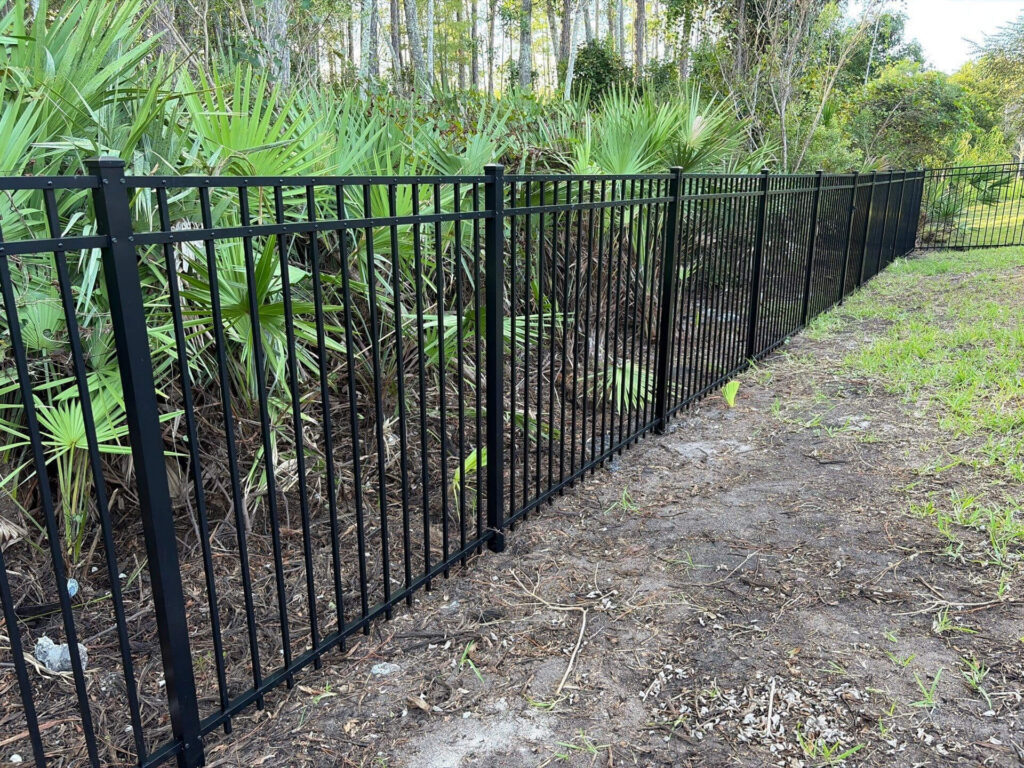
- Aluminum is black, four feet high, and two-rail.
- On a standard lot, the section from the house to the side lot line is aluminum, paired with approved privacy fencing along the eligible rear and side runs.
- Lake and corner lots are aluminum for the entirety, so the shared sightlines stay open. Vinyl between a lakefront lot and a non-lake lot may be approved on a case-by-case basis.
Whatever you install also has to be kept in good repair and attractive condition, which is a standing obligation and not just a condition of approval.
Those are the master association rules. SilverLeaf also has sub-neighborhoods with their own associations and their own property managers, and some carry additional fence guidelines on top of the master rules. Check your closing paperwork or your assessment statement to see whether yours does, and confirm before anything is ordered.
What does the SilverLeaf ARB application require?
Your association’s current form is the final word, so start there. Most submissions ask for some version of the same things:
- The completed architectural application, with your lot and owner details
- A property survey or site plan showing exact fence lines, heights, gate locations, and materials
- A product sheet for the exact material, with the manufacturer’s color name or code
- Your contractor’s information
- Sometimes photos, or signed notices from the neighbors on either side
The detail that trips people up is consistency. Every document in the packet has to say the same thing, so if the application says white vinyl, the product sheet can’t show tan aluminum, and the color on the spec sheet needs to match the color on the drawing. A mismatch gives the board an easy reason to hand the application back, and you lose a review cycle waiting to resubmit.
Some associations also want the installer’s certificate of insurance. We’re a Licensed Building Contractor, fully insured, and we send our COI with the application whenever it’s asked for.
How long does SilverLeaf ARB approval take?
That’s up to your association, and it’s the one part of the timeline nobody can shorten. Ask for the review window before you commit to an install date. We build that period into your schedule rather than quoting you a date we’d have to move later.
Do you need a fence permit in St. Johns County?
If the job runs more than $7,500, yes, always. Below that, it depends on the project. The permit and the ARB approval are separate things, and they answer different questions. The board decides whether your fence fits the neighborhood. The county decides whether the work meets code.
The county also sets a baseline your design has to respect no matter what the ARB approves. Residential fences generally cannot exceed six feet, and typically cannot exceed four feet within the front twenty-five feet of the property line. The fence has to sit on your property, outside public rights-of-way and sight-visibility triangles at corners and driveways. St. Johns County Planning and Zoning is where those requirements live.
We check the requirement for your specific address and pull the permit if yours needs one, after the design is approved. Our Nocatee guide walks through the same sequence for homeowners in that community.
How Fortera handles SilverLeaf ARB approval and permitting
Juliana Pantoja, our Director of Production, manages ARB approvals, permitting, and scheduling. We prepare the architectural review package and submit it for you, so the survey is really the only piece we need from your side. The approval decision belongs to your association, so we won’t promise you an outcome or a timeline on their behalf.
Here’s how it fits into The Fortera Fencing Process.
Your On-Site Consultation
We walk your property, take measurements, and talk through materials and layout against the rules that apply to your lot. You get a free estimate on-site with a full scope of work.
Design & Approval
We finalize the style, layout, and specifications, and those become the drawing, product sheet, and gate plan that go into your ARB application.
Pre-Installation Process
We call Sunshine 811 for utility locates, which is required before any post goes in the ground. We check whether your address needs a county permit, pull it if it does, and schedule your install.
Every fence we build is a 100 mph wind-certified installation. Our in-house crew does the work, with no subcontractors. Aluminum fences go on aluminum I-posts, and wood and vinyl go on galvanized steel structural posts, and either way those posts are driven four feet into undisturbed soil using the iDrive Power System. No concrete. That foundation is 10x stronger than a traditional fence installation, and you can see how no-dig installation works if you want the detail.
Your designated client manager stays with you from the first call through the final walkthrough.
Book a free estimate and we’ll walk your yard, mark the likely fence line against your survey, and leave you with a full scope of work. No deposit required, no obligation.
SilverLeaf fence permit and ARB questions
Can I build a fence before ARB approval in SilverLeaf?
No. SilverLeaf requires written approval before any fence is installed, and building without it puts you at risk of being told to modify or remove the fence at your own cost.
What fence is allowed on a SilverLeaf lakefront or corner lot?
Generally aluminum rather than solid privacy fencing, so the shared sightlines stay open. Vinyl between a lake lot and a non-lake lot is handled case by case, so ask before you plan around it.
How tall can a fence be in St. Johns County?
Generally six feet, and typically no more than four feet within the front twenty-five feet of the property line. Your ARB guidelines may be stricter than the county, and the stricter rule is the one you have to meet.
Can my fence go in the drainage easement behind my home?
Assume not until you’ve confirmed otherwise. Mark every easement on your survey and keep the fence line outside it unless your association and the county have told you in writing that something else is allowed.
What happens if my ARB application comes back?
You correct whatever didn’t match and resubmit, which usually means waiting for the next review cycle. Most of these come down to documents that disagree with each other, which is why the drawing, the application, and the product sheet all need to say the same thing the first time.
Who puts together the ARB application?
You can, or your contractor can. When we do it, the Design & Approval step produces the materials and Juliana submits them.
Premium Fencing. Superior Experience.
Call to Schedule Your Free Estimate Now
Get started today with a free estimate and experience the professional, easy, and dependable service that sets Fortera Fencing apart.

Adrienne Menzies
Adrienne Menzies is Chief Marketing Officer at Fortera Fencing in Jacksonville. She has spent years writing for construction companies and covers Northeast Florida fencing with a focus on what actually holds up: permits, materials, wind ratings, and installation method.