

Hurricane Fence Guide for Jacksonville, FL: What to Know Before, During, and After Storm Season
After a named storm tears through Jacksonville Beach, the cleanup starts fast. Contractors flood the area with flyers. Estimates pile up on the kitchen counter. And somewhere in the paperwork, the phrase “hurricane-rated fence” appears with no further explanation.
What does that actually mean? What test did the fence pass? How deep do the posts go? What happens in saturated coastal sand when wind hits 90 miles per hour?
Most homeowners can’t answer those questions, and most contractors won’t volunteer the answers. This guide will. We’ll cover what hurricane-rated fencing actually involves from an engineering standpoint, how to evaluate your fence after a storm, and how to ask the right questions before hiring anyone.
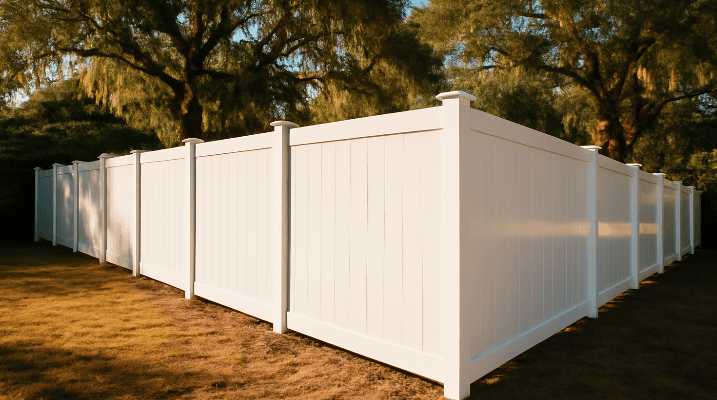
What “Hurricane-Rated” Means for a Fence (and What It Doesn’t)
Florida’s building code establishes design wind speeds for structures like homes and commercial buildings. Duval, Nassau, and St. Johns counties fall within Florida’s wind-borne debris region with design wind speeds of 120 mph or higher for those structures. Fences are regulated differently: they’re typically subject to local setback and height rules rather than the structural wind load requirements applied to buildings.
That distinction matters. A fence contractor who says “we build to code” is meeting a minimal baseline that says nothing about wind performance. The code requirements for fences don’t address lateral wind loads the way building codes do for structures.
A legitimate wind certification comes from the installed system itself: the post, the depth, the bracket hardware, the panel construction, and how those components perform together under lateral load. When Fortera backs a fence installation with a 100 mph wind-certified installation and lifetime workmanship warranty, that coverage reflects the actual engineered system, not a phrase on a brochure.

How Hurricane Winds Actually Destroy Fences
Most fence failures start below the grade line. Understanding why helps you evaluate any contractor’s claims and inspect your own fence before storm season.
Post Depth: The Most Common Shortcut
The informal industry standard for post depth is 24 inches, sometimes less. In Northeast Florida’s sandy coastal soil, that depth doesn’t hold up.
Wind load on a fence panel transmits as a lateral force directly into the post. The post resists that force through friction and bearing pressure against the surrounding soil. Sandy soil, especially when saturated near the coast, provides far less resistance per inch than compacted clay or rocky fill. You need significantly more depth to achieve the same holding power.
In coastal Northeast Florida, 48 inches of embedment is the minimum that performs well under serious analysis. Four feet of post in the ground. That number reflects the lower bearing resistance of sandy soils combined with the lateral loads that Atlantic storm winds generate.
Post Material and Wall Thickness
Thin-wall aluminum extrusions look identical to Schedule 40 posts in photos but behave very differently under load. Schedule 40 refers to wall thickness: a thicker wall resists bending moment (the rotational force wind creates at the base of a post) far better than a thin-wall equivalent.
Steel posts have higher tensile strength than aluminum but require proper coating or galvanization in salt-air environments. Aluminum offers natural corrosion resistance but needs heavy-wall extrusion to deliver comparable structural performance.
A thick-wall post set at 24 inches will still fail. A properly sized post driven 48 inches into undisturbed soil performs as a system. The material and the depth work together.
Brackets, Fasteners, and Salt Air
In a coastal environment like Jacksonville Beach or Fernandina Beach, standard galvanized hardware degrades faster than stainless steel. The salt-laden humidity of coastal Northeast Florida accelerates oxidation on galvanized surfaces.
Stainless steel fasteners and stainless or marine-grade brackets are the correct specification for coastal installs.
The connection between post and rail is the second most common failure point after the post base. A bracket rated for wind load distributes force across the connection. An undersized bracket concentrates stress and cracks under the repeated flex that gusty storm conditions create.
Panel Style and Wind Load
A solid privacy fence and a shadowbox fence experience hurricane winds very differently. A full privacy panel has no air gaps, so every square foot of panel surface area intercepts wind and converts it to lateral load. A shadowbox or open-picket panel allows airflow through the gaps, reducing effective wind load.
Wind load calculations account for panel height, panel style, post spacing, and design wind speed. A taller fence with full privacy panels on wider post spacing requires a heavier post, deeper embedment, or both. These are calculations that can be run before a single post goes in the ground.
Driven Posts vs. Concrete Footings in Jacksonville’s Sandy Soil
This is where Jacksonville’s geology changes the equation in ways that most out-of-state fence manufacturers don’t account for.
Traditional concrete footings work by encasing the post base in a concrete cylinder that distributes the lateral load across a wider area. The assumption is that the concrete stays intact, bonds to the soil around it, and doesn’t shift over time. In stable, compacted soil, that assumption holds reasonably well.
In Northeast Florida’s sandy, high-water-table coastal soil, it holds less well. Here’s why:
Sandy soil doesn’t grip concrete the way clay does. When the water table rises (which in coastal Duval and Nassau counties can be quite high, especially after sustained rain), the soil around a concrete footing becomes saturated. Saturated sand reduces bearing resistance. The concrete footing can rock within that loosened zone. Over repeated cycles of saturation and drying, the footing can begin to shift. Add frost heave (rare in Jacksonville, but not impossible in inland St. Johns County during a hard freeze) and the problem compounds.
Concrete can also crack. A crack in the footing breaks the structural bond and allows water infiltration, which accelerates corrosion on the post base and further degrades the connection over time.
The iDrive Power System takes a different approach entirely. Instead of excavating the soil and replacing it with concrete, it drives steel or aluminum posts directly into undisturbed soil to a minimum depth of 48 inches. The post reaches below the water table into denser, more stable material. It uses the surrounding earth, undisturbed and intact, as the anchor medium.
The result is a post that resists lateral load through continuous soil contact along its full embedded length, rather than relying on a discrete concrete column that can crack and shift. Fortera, as a certified iDrive Power System installer, uses this method on every qualifying installation, which is why the system can be backed by a written 100 mph wind warranty. The numbers behind that claim are verifiable, not just a phrase on a marketing sheet.
The practical benefits go beyond wind performance. No digging means no excavated dirt piling up in your yard. No concrete means no curing time. The installation is cleaner, faster, and causes less disruption to your landscaping.
If you want to see how this method fits into the full installation process, the details of professional fence installation in Northeast Florida are worth reviewing.
Why Concrete Footings Underperform in Coastal Sand
Walk your fence line before your renewal date. This doesn’t require any tools or expertise – you’re looking for the same things an adjuster would note.
Posts
- Stand back and sight down the fence line. Any posts that are visibly out of plumb need attention.
- Check the base of each post for soft spots or discoloration – that’s rot starting at the ground line.
- Push on corner and end posts. They should feel solid. Any movement indicates a failing post base.
- Press your thumb firmly against rails at mid-span. Sound wood won’t flex. Rotted wood will feel spongy or compress.
- Look for missing or cracked pickets, especially on panels that take direct sun exposure.
- Check for boards that are pulling away from the rails at the fasteners.
Metal Fencing
- Look for rust that’s pitted or perforated rather than surface-level discoloration.
- Check post bases and bottom rails – ground contact points corrode first.
- On chain link, look for broken links, bent posts, and sections that have lost tension.
Pool Barriers Specifically
- Measure gate latch height: Florida code requires the release mechanism be at least 54 inches from the ground on the pool side.
- Check that gates are self-closing and self-latching.
- Look for any gaps wider than 4 inches in the barrier itself.
Document What You Find. Take photos with your phone and date-stamp them. If you make repairs, photograph the completed work. This creates a maintenance record you can reference if a future claim is questioned.
The Right Time to Replace Is Before You Need To
Waiting for storm damage to replace a failing fence isn’t a savings strategy. In Florida’s current insurance market, it’s a financial risk that most homeowners don’t fully price until they’re dealing with an adjuster who found your pre-storm inspection notes.
Replacing a fence on your schedule, with materials chosen for Florida’s climate, is a different conversation entirely. The team at Fortera Fencing works with Jacksonville homeowners on exactly this: figuring out what’s salvageable, what needs to go, and which materials actually hold up long-term in this humidity and wind environment.
If your renewal is coming up and you’re not sure what condition your fence is in, reach out for a consultation before your carrier’s inspector tells you first.

Call to Schedule Your Free Estimate Now
Get started today with a free estimate and experience the professional, easy, and dependable service that sets Fortera Fencing apart.